The 3 Metrics That Matter More Than Download Speed The match was in overtime. It was a ranked...
When multiplayer feels unfair
The hidden system's that decide if you trust a match Lede, You slip behind a wall and must believe all is well. A few seconds later, your screen goes red and your character crumples over anyway. Or perhaps your shots are hitting just right, but the enemy is still running around like nothing happened. These instances not only frustrate for many players-they break trust. The frustration normally occurs at a later point. Players break at that point, they retell the situation in their mind, and they put the same question how did that happen? Such situations do not simply influence the result of a single game. They gradually destroy in a player the convictions that the game is being played under reasonable and comprehensible rules. Once the results become senseless, the trust in the system starts to diminish. In an interview, Jay Suhag, a game development practitioner, gave details about fairness in the game: “Fair doesn’t mean it’s easy. It means the rules are clear and the outcomes make sense.”
Why Fairness Is More Polarizing than Ever in the New Multiplayer Games.
Matches and multiplayer games in the present day depend on numerous systems interacting with each other: matchmaking systems, servers, latency compensation, anti-cheat tools, and progress systems. The games today played on multiplayer are far different than the ones played online in the past. Earlier games were based on less complex systems and slower refresh rates, and therefore players were more tolerant of imbalance. Competitive integrity is a promise of modern multiplayer games, which are live services that constantly monitor performance, adapt matchmaking, and track it. Due to this, players now demand fairness to be incorporated in the experience. The fact that that expectation is violated makes the frustration even more heartfelt, as the systems are presupposed to be able to do better. According to Unity 2024 Gaming Report, multiplayer titles are the driving force in the engagement, and they put a lot of stress to live systems. In the meantime, the IGDA Developer Satisfaction Survey 2023 demonstrates the workforce limitation which influences moderation and maintenance. Trust is lost unobtrusively when one system ceases to work.
What Fair really means as a Game.
Emotional investment is also associated with fairness among most players. Professional sports require concentration, time and attention. Players are usually motivated to get better when they feel that they are justified in an instance of a loss. When it is arbitrary, the same investment is resentment. Suhag pointed out this emotional change as one of the largest causes of abandonment of games by the players. Loss is not a problem with players he explained. What they hate is that they feel that their effort was in vain. With time, through the repetitive experiences of confusion, players can develop the habit of losing focus, not queueing to play ranked modes, or withdrawing outright in a game. That is why transparency is as important as balance. Systems do not require being flawless but must be comprehensible. A game that allows players to trace the results to visible choices, such as positioning, timing, coordination, is more likely to accept losses because of the learning process instead of evidence that the game is unfair. With reference to my personal experience in playing competitive multiplayer games, fairness has never been related to victory in every match. I have lost many ranked games that I have played, but still, it felt okay because there was always an explanation why I lost that game, a missed timing, bad positioning, or a superior counter move. Only frustration came in when matches were impossible at the beginning and there was no time to learn and to adapt. At such a time, it was not skill, but the feeling that the system was already determined. Such events describe why gamers frequently abandon competitive gameplay not due to defeat, but because players lost faith in the very game.
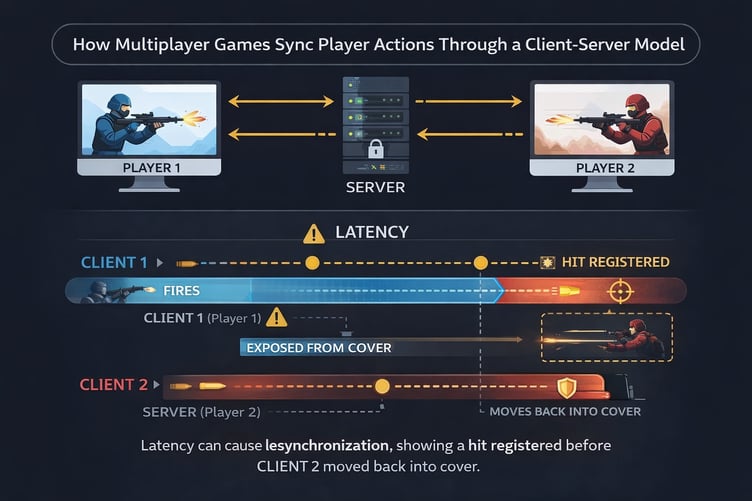
The synchronization of player actions in multiplayer games using a client server model and how latency may lead to a lack of synchronization between the view of players and what is recorded by the server.
Matchmaking: When the Lobby Does Not Matter to your Reality
Matchmaking approximates value-it does not quantify value.
Feels fair when:
Matches are close
Losses make sense
Feels unfair when:
Frequent blowouts
Large skill gaps
Smurf accounts dominate
In strongly asymmetrical ranked games, the outcome seems to be determined during the first few minutes. Goals are achieved too fast, the communication is lost, and the players understand that the difference in the skills is too big to be overcome. However, even the close matches can be considered as fair even when they turn out to be the losers. This distinction is in the fact that the system produced a competition test that can be understood and learned by players as opposed to an experience that seems predestined. When losing can never be explained by the players, Suhag observed that it is usually a match making clarity problem.
Net code and Latency: The Problem of I Died Behind Cover
There are several timelines that are synchronized in online games. Hits may get recorded in the server differently than you would like to see even a few milliseconds of delay. Lag isn’t a skill problem. It’s infrastructure.
Anti-Cheat and Trust Fragility
Cheating transforms the meaning of all the losses by the players. The systems against cheating are based on the analysis of behavior, detection programs, as well as player reports. Catching cheaters and not banning innocent players, Suhag said, is the most difficult part. Clearly portrayed enforcement is more important than technicalities.
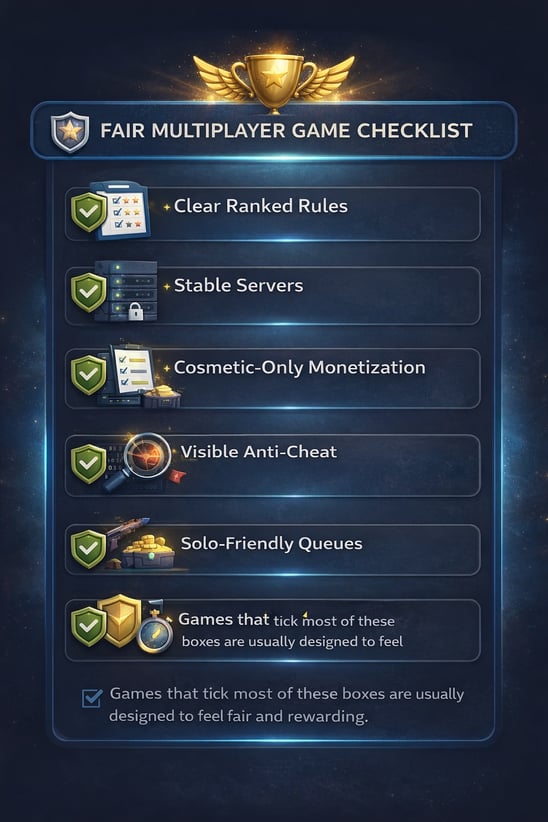
A list of important indicators that players can consider assessing whether a multiplayer game is created to feel fair after some time.
The Competitive Integrity and Monetization
Cosmetics are fine. Paid power is not. As soon as money purchases power, Suhag said, competitive trust is destroyed at once. Paid benefits transform losses during lessons to frustrations.
Solo vs. Balanced Teams Squad Balance
Coordination is power. Ready to play teams are a natural winner when compared to individuals. This is realized by fair systems in solo queues, communication tools and balanced team design.
Closing
It is not hard to blame self or other people when a match is not right. And injustice thrives in institutions. As soon as the players recognize the source, matchmaking, server, anti-cheat, monetization, and team balance, they gain their control. Knowledge about systems does not ensure victories. It restores trust.
CTA
The next time a match does not seem right, stop and call what wrong it was. It is that moment of reflection that can shift your decision on what games are worthy of your time.