When Learning Feels Interactive & Fun: How Videogames Are Reshaping Education
When Learning Feels Like Play: Why Eduational Gaming Is Reshaping How We Learn
For a long time, video games were viewed mainly as distractions. Killing time while playing games was often linked with laziness. However, this mindset is slowly changing. As digital platforms evolve, people are starting to recognize that games involved skills that are useful in real-life learning.
Introduction: Gaming Is No Longer Just for Fun
At some point, almost everyone has opened a game for very different reasons. Some play to relax after work, or simply just to pass time. Others log in to stay connects with friends. What usually starts as entertainment often turn into something more- problem-solving, planning, reacting quickly, or even collaborating with others and persistence; skills that closely mirror real-world learning
“This leads to an important question: Can vireo game support real learning?”
The Rise of Gaming as a Learning Environment
People often do not realize how much they are learning through games. Unlike classroom, video games are not clearly announcing their learning outcomes. There are no formal examinations or grading, yet players constantly analyse situations, making choices, and adjust their strategies when something is not working. They learn through failing, adapting and trying again.
This idea became clear during primary interview research with a casual video game enthusiast and full-time digital marketing student, Harshil. Gaming has been part of his routine for many years. When asked how he discovers new games, he said-
“If any new game launches, I always go and watch that trailer...if the game has already launched, I watch some gameplay video on streaming platforms or on YouTube.”
This habit shows how modern gamers learn by observing others, analysing gameplay strategies, and deciding what interests them. Watching live video game streaming is not passive consumption rather than it is a form of informal learning, where people study techniques, outcomes and decision-making in real time.
Games also encourage creativity and experimentation (Trial and Error Method). Strategy games, simulation games, and multiplayer environments push players to think ahead, solve complex issues, and adapt to challenges and respond to them in real time- all without the pressure often associated with traditional learning.
The Psychology Behind Learning Through Play
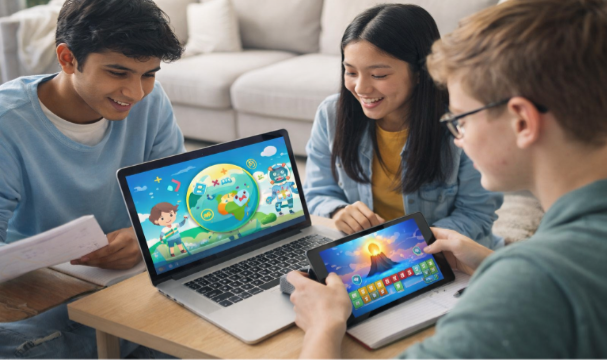
Educational psychologists have long emphasized the power of learning through play. Play-based environments rely heavily on trial and error, allowing learners to make mistakes safely. Instead of worrying about failure, players except it and are motivated to try again.
This aligns with findings form Wirecutter (The New York Times), which notes that learning is most effective when users do not feel like they are studying. The article explains that strong educational games help build problem-solving and logical reasoning skills, while it also supports the idea of emotional awareness and self-expression.
In the interview Harshil echoed this idea when discussed about his gaming experience. He shared his perspective which is like the article from Wirecutter and said-
“It’s mostly entertainment for me, but learning is also a big factor.”
The Role of Game Streaming in Learning
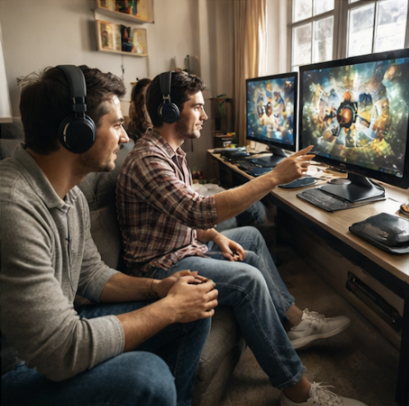
Game streaming platforms like YouTube gaming have changed how people interact with games. Many players learn by watching others play, especially skilled players. Harshil described how watching skilled players on streaming platforms helped him understand games better he said-
“I like watching how skilled players approach a game...how to solve problems, or how they grow over time.”
These streaming platforms function as an informal learning spaces, where viewers can observe strategies, discover new genres, and observe problem-solving techniques. Multiplayer games also add a social learning element. As Harshil mentioned:
“I mostly play multiplayer games....it helps to make new friends.”
This social element turns gaming into a shared learning space where players exchange ideas, support one another, and built communities across the World. These interactions encourage communication, teamwork, and community building.
Challenges and Misconception Around Gaming and Learning
Despite the benefits of gaming, it is not without criticism. Common concerns include excessive screen time, distraction, and feeling of unproductivity. These concerns were acknowledged during the interview- As Harshil reflected honestly on this balance-
“Sometimes it feels like a loss of track of time.... gaming can be relaxing, but without balance, it can feel unproductive too.”
This highlights a crucial point; gaming itself is not inherently harmful or beneficial- intentional use matters for minor users, parental control, time limit, and purposeful game selection can help transform gaming from passive entertainment into an active learning tool.
What the Future of Learning Through Games Could Look Like
As technology advances, gaming platforms are expected to become more personalized and adaptive. Harshil believes artificial intelligence will play a major role:
“Gaming platforms will become more personalized and interactive...better AI-driven recommendations, maybe improved clod gaming.”
Nowadays gamification has also become a part of workplace training and professional development. Many companies now use game-based training and development session for the employees.
Secondary research from the Resonant Are Podcast supports this shift. The podcast highlights how video games help develop spatial awareness, resilience, and practical mathematics. Sports games, for example, introduce players to statistics, probability, and data interpretation in engaging ways. These facts suggest that games are not replacing traditional education but complementing it.
Conclusion: Rethinking What Learning Can Become
So, how do we learn through gaming?
The answer lies in experience. Games create environments where learners observe, experiment, fail, collaborate, and persist- all important components of meaningful learning. Whether it’s solving puzzles in chess, building community in multiplayer games, or learning strategies through streaming platforms, gaming reshapes how people engage with knoledge.
The next time gaming feels like “just play,” it may be worth pausing to reflect. Underneath the graphics and gameplay, learning might already be happening- quietly, naturally, and knowledge.
Title Tag
When Learning Feels Like Play: How Video Games Are Changing Education.
Meta Description
Explore how video games support learning through play, problem-solving, and community, using real interviews and research-based insights and findings.
For more details
Check this: https://x.com/Devanshi3804221/status/2023586201249194150?s=20
Podcast Link: https://www.youtube.com/watch?v=GBqNVfjTuYg
Follow us on X: https://x.com/Devanshi3804221/status/2023551160716849484/photo/1