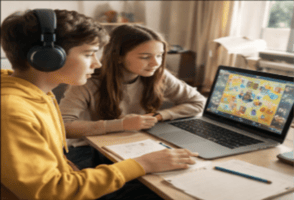

She thought she was ready.
How Engagement Transforms Education:The Role of Games in Modern Learning
When Learning Stops Feeling Like Learning
Introduction:
The current technological era made learners more interested in seeking interaction that would make their educational experience more valuable and entertaining. Conventional forms of learning are frequently not able to maintain the attention particularly in a world that is characterized by interactive screens, digital experiences and constant stimulation. Games in education have been defined as one of the most involving methods of filling this vacuum to make learning an interactive and fun activity. Children have a natural affection towards learning through play and when presented in a form of a game, learning is stimulated and participation and interest are promoted. Instead of considering it a task, learning starts to be perceived as an experience one that brings the elements of education and interaction together, without disrupting the harmony.
Learning should not be meaningless to the students because this will render it long. Learners lack intrinsic motivation and, therefore, the education process becomes superficial. Here game based learning comes into the picture. Educational gaming provides an environment where students are naturally motivated to remain engaged and interested; it provides engagement, challenges, rewards and immediate feedback. These components initiate the desire to learn and not to make it compulsory, and it turns out to be meaningful and pleasant to learn.
Participation is important in the process of knowledge assimilation and retention among students. Engagement of learners enhances their concentration and attention levels and hence they are able to process information at a deeper level. Children are active participants rather than passive receivers of the content they ask questions, like to explore ideas, and like to make significant connections. The use of educational games helps encourage this active engagement, as it involves the players to think, make choices and act immediately.
Another important consideration is emotional connection. Games tend to arouse excitement, interest or a feeling of accomplishment which enhances emotional engagement in the learning material. This emotional response enhances the remembrance of lessons and effect. Also,the existence of difficulties and incentives inspires perseverance. When concepts become challenging, learners are more likely to make attempts again,break the barriers, and proceed with the learning.
Last, there is increased standing of the learner as the learner is more likely to apply what is learned outside the game. When students learn using knowledge in interactive situations, they start to realize how learning is related to real life situations. Educational gaming aids in further comprehension, lasting learning and using information in practice through interaction.
A Psychological Perspective on Educational Games-
Psychologically, it has been confirmed that educational games can have a positive effect on the well being and cognitive development of children, when they are made to meet the requirements of the learners. Studies point out that well-structured games may facilitate the developmental needs of a child in terms of autonomy, competence, creativity and identity which are critical in motivating and promoting healthy development in a child. As the learners become confident that they have control of their decisions and developments, there are higher chances of them remaining engaged and emotionally involved in the learning process.
Emotional regulation and social development is also a result of educational games. Interactive play may assist learners to deal with such emotional reactions like frustration or excitement, where as collaborative or story-oriented games may foster relationships and empathy. These psychological advantages make learning experiences to be less threatening, more friendly and more enjoyable particularly to younger learners.
Besides emotional well-being, educational games maybe used to develop significant cognitive abilities. Research indicates that game-based learning has the potential to enhance working memory and impulse control as well as problem-solving skills, and possibly be associated with higher cognitive skills in children and adolescents. These are skills needed in academics and in decision-making.
Nevertheless, the education gaming should also be approached with moderation. Highly competitive or violent games has been reported to have detrimental mental health and academic consequences. This emphasises how crucial deliberate game design and usage guidance are. Educational, age-appropriate, and purpose-driven games can help to promote psychological wellbeing, as well as cognitive development in a manner that is meaningful.
Storytelling in Learning: Academic Perspective-
As technology keeps on becoming part of the school system, storytelling has emerged as an increasingly useful tool on the part of the teacher. Video games in academics are increasingly becoming common in classrooms not just as playing games, but as effective learning activities. It has been noted by many educators that when lessons are taught in a form of stories and interactive game play, the students are more interested, understanding, and participatory.
Some of the results that teachers tend to record as a strong learning outcome include literacy, mathematics, oral language development, and new language immersion. The narrative games promote reading instructions, following a story, problem-solving, and the exchange of ideas in students and keeping them absorbed in the learning process. In a language learning classroom, storytelling also allows the students to apply vocabulary and understanding in context instead of in drills, and makes foreign and second language learning more accessible and more entertaining.
These classroom observations are supported by research. A systematic review by Martinez and colleagues (2022) revealed that video games whether educational or entertainment are learning methods that are effective in various academic fields, starting in preschool and up to college. Learning foreign languages and science were the subjects that showed the best improvements because of the interactive and narrative quality of games, which was instrumental in helping in understanding and memorizing. The lesson plan used by teachers that students were put in the middle of a story, they are become active learners, not passive learners.
Educationally,game-based storytelling assists in relating the academic material to the real-life. The incorporation of learning objectives into the storylines of educational games can help learners develop their understanding, maintain attention, and have self-belief in education. In the case of teachers, it willturn the lessons into an experience where they can be used to not only meet the objectives of the curriculum but also appeal to the students.
Conclusion: Learning as an Experience, Not a Task
With the continued evolution of learning in a world that has been driven by technology, interaction has become one of the most crucial aspects of the relationship between the students and their learning. In response to this change, educational games take the form of integrating challenge, interaction, and telling stories in a manner that fosters curiosity as opposed to obedience. When the learners are emotionally connected, inspired and engaged, learning is not memorised but more significant and long-lasting.
Psychologically, effective learning games contribute to cognitive, emotional and intrinsic motivation. They assist the learners to develop confidence, persistence, and problem solving skills but in the process they retain a sense of autonomy and creativity. These experiences may be used constructively to affect academic achievements and the general well-being when done well.
The views of the teachers also demonstrate the usefulness of storytelling in education. Educational games provide context so that educational literacy, mathematics, oral language, and language immersion seem relevant and engagingto students by embedding them in the context of a story. Stories help learners to discuss the ideas, make choices and use the knowledge in the way that represents the real-world thinking.
Finally, educational gaming proves that learning should be experienced not just by implementing play, story, and choice but also students will be willing to be more involved, think critically and have a lifelong relationship about learning.
The link below can be accessed for my full video podcast. Click now...