Finishing a video game used to feel clear-cut. You played through the story, hit the final mission,
Stroke rehabilitation is entering a new era, one driven by immersive technology, data, and experiential learning. While various platforms are advancing how recovery is measured, another critical shift is emerging. At the forefront of this transformation is STAPPI VR Inc. This is a pioneering health-tech company using immersive virtual reality (VR) to improve both patient recovery and clinician training. Traditional rehabilitation is often repetitive, physically demanding, and emotionally discouraging, leading to low patient adherence and slower recovery outcomes.
STAPPI VR transforms this experience by turning therapy into:
- Interactive virtual environments
- Gamified rehabilitation exercises
- Emotionally engaging recovery journeys
This approach is strongly supported by research. A study published in Frontiers in Neurology (2019) found that virtual reality-based rehabilitation significantly improves patient engagement and motor recovery in stroke patients compared to conventional therapy methods.
Reducing Clinician Workload While Improving Care
Beyond patient experience, healthcare systems face increasing pressure on clinicians, particularly in monitoring, documentation, and treatment adjustments.
STAPPI VR addresses this by:
- Automating patient performance tracking
- Delivering real-time analytics and insights
- Reducing time spent on administrative tasks
According to research published in the Journal of Medical Internet Research (2020), digital health technologies, including VR, can significantly improve clinical efficiency by reducing documentation burden while enhancing monitoring accuracy.
The Hidden Challenge: A Skills Gap in Rehabilitation Training
While technology is improving patient care, there remains a critical gap in how clinicians are trained.
Many students and practicing professionals face:
- Limited exposure to real stroke rehabilitation cases
- Insufficient hands-on practice
- Outdated or theory-heavy training methods
This creates a disconnect between academic learning and real-world clinical demands.
Why Immersive Learning is More Effective
Immersive VR technology provides a solution by enabling realistic, hands-on training experiences. Research from Harvard Business Review (2020) shows that learners trained with VR are up to four times more focused than traditional learners and demonstrate a 275% increase in confidence when applying learned skills. Additionally, a study in Medical Education (2021) found that simulation-based training significantly improves clinical decision-making and long-term skill retention among healthcare students.
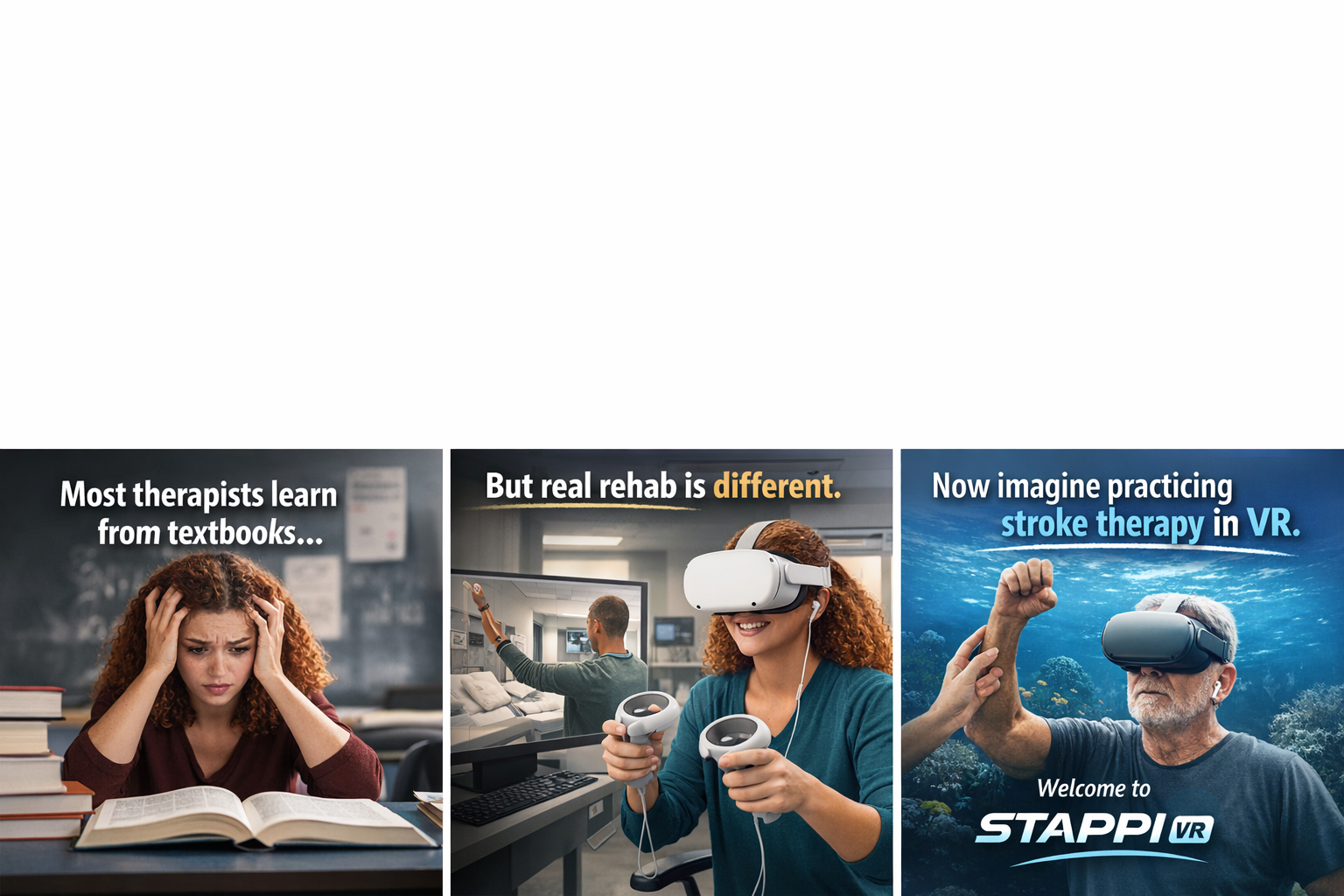 Source: Image Generator Students need real-life experiences, not just theory
Partnering with Universities to Train the Future Workforce
Recognising this gap, STAPPI VR Inc. is partnering with universities and training institutions to integrate immersive VR into clinical education.
Through these partnerships, students can:
- Practice stroke rehabilitation techniques in real-time simulations
- Engage with lifelike patient scenarios
- Develop clinical confidence before entering practice
Real-Life Simulation: Bridging Theory and Practice
One of the most powerful aspects of VR training is its ability to simulate real-world clinical environments. According to the National Institutes of Health (NIH), simulation-based learning improves clinical competency by allowing repeated exposure to realistic scenarios without risk to patients.
This means students can:
- Make mistakes safely
- Learn through repetition
- Build practical skills faster
Upskilling Today’s Clinicians
STAPPI VR is not only focused on students, it also supports practicing clinicians. Through subsidized courses and training programs, the company helps professionals:
- Stay updated with modern rehabilitation techniques
- Integrate new technologies into practice
- Enhance patient outcomes
This ensures that both future and current clinicians remain competitive in a rapidly evolving healthcare landscape.
Conclusion: The Future of Stroke Rehabilitation is Immersive
The future of rehabilitation is not just about better tools—it’s about better outcomes driven by:
- Higher patient engagement
- Reduced clinician workload
- More effective training systems
By combining immersive therapy with advanced education, STAPPI VR Inc. is not only improving recovery but also training the future workforce in rehabilitation.
Whether you are:
- A university looking to modernise clinical training
- A clinician aiming to upgrade your skills
- A healthcare provider seeking better patient outcomes
STAPPI VR is your partner in shaping the future of stroke rehabilitation