
How Engagement Transforms Education:The Role of Games in Modern Learning When Learning Stops...
In the early days of learning encryption, Keshav, a student in cybersecurity, found the subject overwhelming.
He says, "There was so much math involved, it felt like rocket science."
Like most beginners, he struggled to understand how abstract concepts applied in practice. Textbooks explained theory, and lectures described the steps, but understanding how concepts applied in practice remained difficult. One day, he decided to learn encryption through a game.
That’s when everything finally clicked, he recalls.
Keshav's experience reflects how gamified learning can help beginners engage actively with complex topics. Gamified learning encourages students to engage actively rather than passively receiving information—a distinction especially important for those dealing with complicated subjects.
Why Students Struggle with Complex Subjects
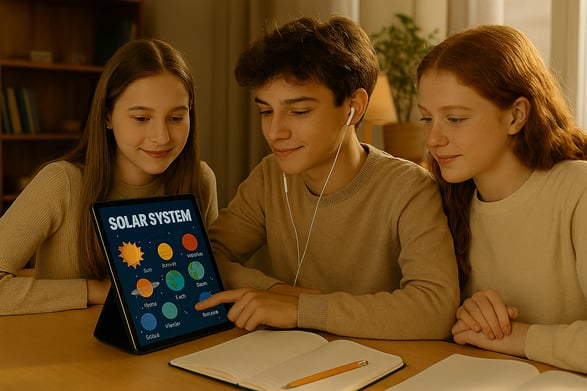
Traditional learning methods often rely on repetition, memorization, and passive listening. For many students, especially younger ones, this style may feel disconnected from how they naturally interact with the world. According to Statistics Canada, over 85% of Canadian youth aged 10–16 use tablets or laptops for learning. Yet conventional classrooms rarely match the interactivity and engagement these students experience with digital tools.
- Gamification breaks complex concepts into small tasks.
The ability of gamified learning to divide complex ideas into small interactive tasks is one of the greatest strengths of the learning method.
For Keshav, encryption concepts were presented in short, manageable challenges instead of long explanations. He says each game focused on one small concept at a time. This approach helped make the material less overwhelming. Students can develop understanding bit by bit, addressing concepts one by one, without feeling confused before they even start. - Play-based learning promotes experimentation.
Mistakes are often stressful in traditional classrooms, but in games, errors are expected and encouraged.
"The freedom to experiment without consequences greatly boosted my confidence," Keshav says. "I tried again and again whenever I got something wrong." This low-pressure atmosphere enables students to experiment, learn through mistakes, and learn through the natural process. According to research by YouthREX, interactive digital tools may enhance interaction because they lower anxiety related to performance, particularly among beginners (YouthREX, 2021). Students start seeing mistakes as a natural part of learning rather than something to fear. - Games make learning a challenge, not a chore.
Motivation is critical for student learning. Keshav notes that the game format made learning feel like a challenge rather than a chore, and he wanted to keep going. Students are provided with visible evidence of progress through progress bars, instant feedback, and problem-solving elements. These small victories keep learners engaged—something that traditional worksheets struggle to achieve. - Gamified learning visualizes abstract ideas.
Some concepts are difficult simply because students can’t see how they work.
“I was playing a Caesar Cipher game,” Keshav recalls. “At one point, everything suddenly made sense.” Seeing encryption happen in real time rather than reading about it helped him understand the logic behind the concept. The visualization and interaction processes help to transform abstract concepts into experiential activities that students can engage with. It is particularly useful in STEM and technical subjects, where the knowledge learned is usually reliant on practice. - Confidence grows as students experience success.
Confidence comes not from memorizing answers but from understanding the material. Keshav describes that concepts that seemed to be confusing in textbooks became very clear when he was able to interact with them. Games help students feel capable and confident as they achieve success. Such confidence can be transferred to other learning activities and foster curiosity as opposed to avoidance. Gamified learning isn’t just about content; it helps students believe they can learn.
What this means for students, parents, and educators
Most Canadian youth already use digital devices for learning, so the question is not whether to embrace technology, but how to use it effectively.
Gamified learning is a methodology that fits quite well with the natural way of interaction, feedback, and challenge as processes used by students. When carefully planned, it can assist in understanding, motivation, and confidence—particularly for intricate subjects.
As Keshav summarizes:
“The game-based learning experience taught me that even complex technical subjects can be fun when approached in the right way.”
Closing thoughts
Not all students learn the same way, and that’s perfectly fine. Gamified learning allows students to learn at their own pace, turning lessons into experiences rather than instructions.
Interactive learning may be the key ingredient for learners who feel overwhelmed by traditional methods. If your child struggles with abstract or technical topics, gamified learning can make lessons more understandable, engaging, and confidence-building.
Primary Research
VideoLink: https://drive.google.com/file/d/16x1N0WduaCiZmkG6hdFFhKczt6P33gzL/view?usp=drivesdk
Audio Podcast
Link: https://drive.google.com/file/d/1G7-9Xkjk655DwGs6Ll3YjZCGCxXvY5N-/view?usp=drivesdk
Instagram Post
Link: https://www.instagram.com/ankita_rahemani_brainboosters?igsh=MTFmd29lbThraHEyaA%3D%3D&utm_source=qr